
#1
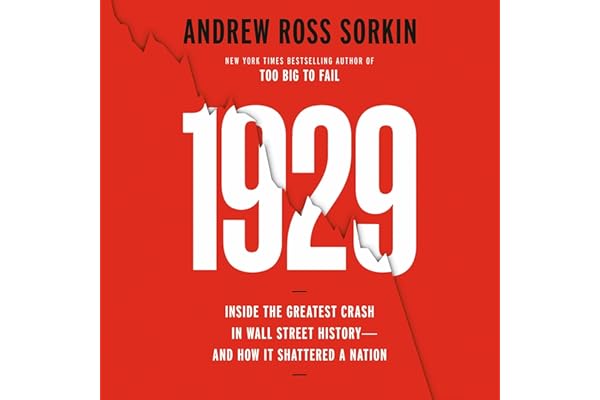
1929: Inside the Greatest Crash in Wall Street History–and How It Shattered a Nation
Price: $20.48
What Customers Say:
-
bernard salzman“History That Feels Strikingly Current”1929 by Andrew Ross Sorkin is a brilliantly written, highly readable account of the events leading up to the Great Crash. Sorkin brings the era to life with sharp storytelling, clear explanations, and impressive research. Despite knowing the outcome, the narrative feels gripping and surprisingly suspenseful.What makes the book truly stand out is its relevance—many of the themes he highlights, from speculation to overconfidence, echo in today’s markets. It’s a powerful reminder that the past still has lessons to teach.A smart, engaging, and insightful read. Highly recommended.
-
Gil GreggsNot In Our Stars, but in OurselvesAndrew Sorkin’s book on the Crash of 1929 is a delight to read. The praise that has been showered upon it is well deserved. It is well researched and so well organized and so well written that it reads more easily than the morning paper. Sorkin’s interest is not so much in the details of stock trading and margin calls but in gaining some purchase on the dark heart of human greed that drives all market bubbles. For Sorkin the Crash is not something that is best understood through the application of macroeconomic analysis– thank goodness– but through the story of human ambition darkened by human avarice. This story is necessarily one of tragedy. The Crash is not so much to be explained as to be narrated. This narrative requires our sympathy more than our judgement. We cannot understand market bubbles, he implies, unless we understand human nature and how we are all susceptible to enticements that make little sense as well as the need to assign blame and identify virtue. We know we are reading a very different approach to the Crash when the story opens with “Sunshine” Charlie Mitchell bounding up the “steps of 55 Wall Street” where he will exert his usual “confidence and certitude” on what was the “crushing afternoon” of October 28, 1929. Apparently, the key to understanding that fateful afternoon lies not in complications of stock trading but in understanding the temperaments of the men who made the trades, launched the schemes, and reaped the benefits. Sorkin is careful, however, to keep his story from becoming a morality play. He shows us the characters and asks us to find a connection with them, an affinity, so that when the tragic moment comes, we do not so much as judge them as identify with them. This is no small achievement. In this book Sorkin becomes Eric Larson and the Crash of 1929 becomes our story as well as the story of Sunshine Charlie, Tom Lamont, Will Durant, George Whitney and all the others. This is high praise. When George Whitney comes to beg a personal loan from fellow Morgan Partner Tom Lamont after discovering that his brother Richard Whitney had been stealing money from clients in his bond trading firm, we feel deep sadness for how people can fail, pity for one brother trying to help another brother, admiration for a partner bailing out a colleague, and a sense of head shaking disgust for how we all lie to ourselves in such moments. It is here we realize again that Sorkin is giving us a history more akin to Greek tragedy rather than an analysis of how markets fail or of how banks and investment firms need to be regulated. Sorkin does this at every moment in his story of the history of the Crash. And he does it masterfully. The story of the Crash becomes something of a Vanity Fair. Sorkin does not lecture the reader, he simply invites our sympathies to understand, or better, he implies that understanding requires our sympathies. Before reviewing the final tragic act in the life of stock shorting master Jesse Livermore, Sorkin poses a rhetorical question for the reader: “What did it feel like to move through the world of money and power with complete confidence, only to see it all vanish, as if you were no less expendable that those living in Hoovervilles?” This is another masterful move– he asks us in the end to see Livermore, the avaricious short-seller who made a hundred million dollars shorting stocks in the Crash, who sits at a table in the Stork Club bereft of his fortune, as one of the inhabitants sitting in the shanty of a Hooverville. Then he adds one of the best lines in the entire book: “The make ego certainly took a beating in the aftermath of the crash.” What?! Was it aggressive male greed that brought this all about? Yes, he implies, and in fact he is certain of it. Masterful. Then just a few short lines later he offhandedly notes that Livermore is his wife Harriet’s fifth husband.Sorkin has given us something new. A new way of understanding financial markets, bubbles, crashes, government reactions to such things, and why they happen. He has given us nothing less than a new set of questions to ask about these moments of economic disaster. Why, he asks, is the project of constructing the Empire State Building launched in the midst of the market run up to the Crash? Is it just coincidence that the phallus of American commerce was erected when it was, or is there some portent here? Mercifully Sorkin does not explore this question more than simply imply it. He lets us do the work, draw the connection (or not), and wonder about the role of male ego in all of this.Even President Hoover gets a softer, gentler review. Long the punch line and scapegoat for what went wrong, Sorkin cautions us to slow down and look again. Hoover is portrayed as trying his best. Isn’t that all any of us can ever do? Roosevelt, long celebrated as the savior in our darkest hour, is presented as woefully cheery and optimistic and lacking in knowledge of banking and economics. Somehow Sorkin makes this portrayal refreshing.Sorkin knows that the explanation he works to reveal does not lie within the kind of analysis published in academic economics journals, but within the mystery of dark hearts and pitiable human foibles. To this end John Maynard Keynes is hardly mentioned, nor is Friedrich Hayek. Irving Fisher and Roger Babson are granted entry into the drama but only to show that one of them got it right (Babson) and the other, the most famous economist in America at the time, Fisher, got it wrong. Perhaps wisely, Sorkin refrains from drawing easy parallels to the overvalued markets of today. Again, he leaves that to the reader and to his comments on television as he promotes this fine book. That is as it should be, but make no mistake, this story of the Great Crash of 1929 and the Great Depression that followed, is completely relevant to today. This is a great book.
-
Al FryBlow by blow account, people in the midst of the panicInteresting book, but fails to focus more sharply on the scurrilous activities of grifters pretending to be gentlemen and the enormous damage caused to countless people who trusted their bankers.As with the concerted financial fraud of 2008, those responsible get off very lightly, cushioned by wealth, political favour and a corrupt environment.Stand by for the next panic, ready to be served to one and all soon. Driven by greed, humans learn nothing, except to finesse the next one.
-
ZumDumThis is a Compelling, Informative ReadIf you’ve ever wanted to know what went on behind the scenes during the epic stock market boom and bust of the 1920’s, this book’s for you. It’s all about bankers and banks, especially New York City’s big investment banks. But don’t just yawn and push it away.The author meticulously researched the topic, from private letters, public and private collections, government files, personal interviews, and newspaper and press files. His story exposes an intimate view of the lives and families of the principal players. At the front, he gives a cast of characters in the story, along with their professional affiliations—very useful for keeping the reader on track. The book is over 400 pages, but its page design and typeface allow for easy reading, even late at night. The author builds the tension with each chapter, and you will want to start the next.The author explains how excessive borrowing of money for speculation on the New York stock exchange led to a meteoric run up of the Dow-Jones average. He describes the quasi-legal, but immoral schemes the banking executives used to manipulate the market and create profits for themselves—to the disadvantage of smaller investors. Deep-pocketed investors pooled massive amounts of money to buy or sell huge blocks of stock to force the stock price up or down, as needed.The over-rich banking executives formed an aristocracy in New York and around the world, living luxurious lives in multiple palatial homes. The bankers placed big, leveraged bets on the markets, making or losing outrageous sums of money on a single trade. Small investors across the country borrowed money to join in the speculative orgy, hoping to get rich quick.When the bubble popped, banks throughout the country did not have the money—all loaned out—to pay frantic depositors clamoring to get their life savings back. Thousands of banks failed. The resulting Great Depression led to massive, long-term unemployment and breadlines. The Dow-Jones did not recover its pre-crash high until 25 years later.President Herbert Hoover—a believer in keeping the government out of the financial markets—started a widely publicized Senate hearing on the cause of the crisis, which struck a favorable chord with the public. Franklin Roosevelt, the incoming president, temporarily closed the nation’s banks, took the dollar off the gold standard, and increased the money supply. He sensed the public’s mood for banking reform and instituted banking protections we enjoy today: separation of investment and commercial banking, federal deposit insurance (FDIC), and securities and exchange commission (SEC). I believe the author was a little soft on Hoover, often cast as the villain, and pressed a bit hard on Roosevelt.Will it happen again? Probably. Will it be as bad? Not likely, unless our current government continues to chip away at banking regulations. In the concluding words of the author:“… the forces that drove the market to such stratospheric levels—optimism, ambition, and the belief that the future could be endlessly brighter—did not disappear forever. They never do. … we need to remember how easily we forget … The greater the heights of our certainty, the longer and harder we fall.”As they might say in New Orleans, “Laissez les bons temps roulez!”
-
Timothy BerkeyA must read for all of usAndrew skillfully walks the reader through the lead up and aftermath of the 1929 crash. His writing style keeps you highly engaged. It’s a real page turner that reveals the personalities involved and their personal stories. You don’t have to be knowledgeable of Wall Street to follow his stories. The short chapters allow the reader to stop and reflect. And the list of the players and positions was quite helpful. I wish his book was available when I studied business as an undergrad. It pulls so many issues together and explains motives from different perspectives. This book most assuredly will become a classic.
1929: Inside the Greatest Crash in Wall Street History–and How It Shattered a Nation is one of the best-selling products with 1817 reviews and a 4.6/5 star rating on Amazon.
Current Price: $20.48