

#1
The Big Short: Inside the Doomsday Machine
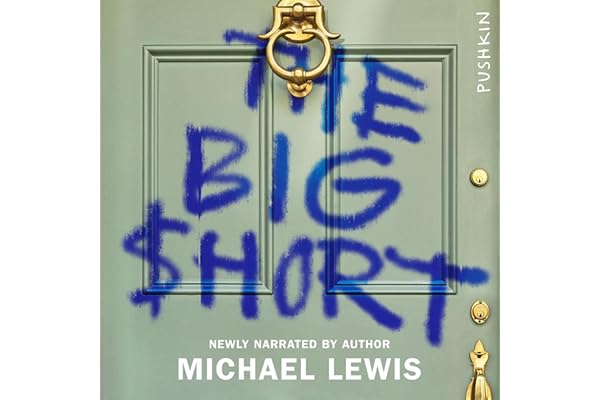
Price: $21.84
What Customers Say:
-
AdamSmytheWho knew?Based on reading Michael Lewis’ Liar’s Poker and Moneyball, I wondered whether The Big Short would prove to be entertaining and informative. If you’ve read some of Lewis’ books, you might agree that the “entertaining” part would seem to be a reasonably safe bet. It turns out, it is. The Big Short is fast-paced, straightforward, conversational and salty–very much like his earlier works. Indeed, if you didn’t know Michael Lewis had written this book, you could probably guess it. It is easy reading and very hard to put down. In short (no pun), The Big Short doesn’t disappoint in being entertaining.In a sense, this book is similar to Moneyball in that Lewis tells his story by following a host of characters that most of us have never heard of–people like Steve Eisman (the closest thing to a main character in the book), Vincent Daniel, Michael Burry, Greg Lippmann, Gene Park, Howie Hubler and others.How informative is the book? Well, it may seem that Lewis has his work cut out for himself, since the events of the recent financial crisis are already well known. More than that, lots of people have their minds made up concerning who the perps of the last few years are–banks and their aggressive managers, “shadow banks” and their even more aggressive managers, hedge funds, credit default swaps, mortgage brokers, the ratings agencies, Fannie Mae and Freddie Mac, the Fed’s monetary policy, various federal regulators, short sellers, politicians who over-pushed home ownership, a sensationalist media, the American public that overextending itself with excessive borrowing (or that lied in order to get home loans), housing speculators, etc. The list goes on–and on. Okay, so you already know this. The defining aspect of this book, however, is that it asks (and answers) “Who knew?” about the impending financial crisis beforehand. Who knew–before the financial crisis cracked open for everyone to see (and, perhaps, to panic) in the fall of 2008–that a silent crash in the bond market and real estate derivatives market was playing out? Indeed, the good majority of this book addresses events that occurred before Lehman’s failure in September of 2008. In describing what led up to the darkest days of the crisis, Lewis does a good job helping the reader to see how the great financial storm developed. All in all, this is an informative book.Interestingly, in the book’s prologue, Salomon Brothers alumnus Lewis explains how, after he wrote Liar’s Poker over 20 years ago, he figured he had seen the height of financial folly. However, even he was surprised by the much larger losses suffered in the recent crisis compared to the 1980s, which seem almost like child’s play now.For a taste of The Big Short, Steve Eisman was a blunt-spoken “specialty finance” research analyst at Oppenheimer and Co., originally in the 1990s, and he eventually helped train analyst Meredith Whitney, who most people associate with her string of negative reports on the banking industry, primarily from late 2007. Giving a flavor of his style, Eisman claims that one of the best lines he wrote back in the early 1990s was, “The [XYZ] Financial Corporation is a perfectly hedged financial institution–it loses money in every conceivable interest rate environment.” His own wife described him as being “not tactically rude–he’s sincerely rude.” Vinny Daniel worked as a junior accountant in the 1990s (and eventually worked for Eisman), and he found out how complicated (and risky) Wall Street firms were when he tried to audit them. He was one of the early analysts to notice the high default rates on manufactured home loans, which led to Eisman writing a 1997 report critical of subprime originators. Michael Burry (later Dr. Michael Burry) was, among other things, a bond market researcher in 2004 who studied Warren Buffett and Charlie Munger, and who correctly assessed the impact of “teaser rates” and interest rate re-sets on subprime loans. In 2005, Burry wrote to his Scion Capital investors that, “Sometimes markets err big time.” How right he would be.Greg Lippmann was a bond trader for Deutsche Bank, who discussed with Eisman ways to bet against the subprime mortgage market. Before home prices declined, he noted, for example, that people whose homes appreciated 1 – 5% in value were four times more likely to default than those whose homes appreciated over 10%. In other words, home prices didn’t need to actually fall for problems to develop. (Of course, home prices fell a lot.) When Lippmann mentioned this to a Deutsche Bank colleague, he was called a Chicken Little. To which, Lippmann retorted, “I’m short your house!” He did this by buying credit default swaps on the BBB-rated tranches (slices) of subprime mortgage bonds. If that’s not a mouthful, read further in the book for a description of Goldman Sachs and “synthetic subprime mortgage bond-backed CDOs.” Then there’s the AIG Financial Products story, told through the story of Gene Park, who worked at AIG, and his volatile boss, Joe Cassano.Did I say this book is informative? Here’s a bit more: Did you know that a pool of mortgages, each with a 615 FICO score, performs very differently (and better) than a pool of mortgages with half of the loans with a 550 FICO score and half with a 680 FICO score (for a 615 average)? If you think about it, the 550/680 pool is apt to perform significantly worse, because more of the 550 FICO score loans develop problems. Think about how that got gamed.There’s more, but hopefully you’ve gotten the point. This is a very interesting, entertaining and informative book that accomplishes what it sets out to do. Chances are you’ll enjoy it.
-
Jay PA hilarious yet strikingly bleak look at the world of financeIn describing the behavior of Wall Street bankers prior to the financial crisis, many adjectives have been bandied about. Greedy, say some; arrogant, claim others. What is only now beginning to gain ground on these populist declarations of discontent is a third, and far more horrifying, descriptor: stupid. This trait may at first seem less offensive to those of us who flaunt our self-prescribed moral superiority over these perceived miscreants. The reality, however, is anything but comforting. In The Big Short: Inside the Doomsday Machine, Michael Lewis, author of Moneyball and Liar’s Poker, dabbles in the thriller genre, often to hilarious effect, as he details the inner workings of a financial world that was truly ill-prepared for its inevitable Waterloo.I’ll admit it: The Big Short is a very, very entertaining book. Mine is an admission whose sheepishness can only be understood once one has finished reading the book. It reads like a John Grisham novel, yet John Maynard Keynes is a far likelier neighbor on a library shelf. Lewis is profligate in his use of such terms as “big Wall Street firms” (32 occurrences, according to Google Books) and he is wont to transcribe entire conversations whose accuracy is often questionable but whose content leaves the reader in stitches.Ultimately, it is funny, isn’t it? Here were our best and brightest, as David Halberstam might say, assuring us that our money was safe, that real estate prices would continue to rise, that subprime loans were the healthy product of a heightened ability to reduce risk, not a house of cards upon which much of the global economy now rested precariously. And they were wrong, not because they intentionally lied (though some did), but because they failed to recognize the bright red flags everywhere on (and sometimes off) their own balance sheets.The Securities and Exchange Commission’s civil lawsuit against Goldman Sachs this week has resulted in even more vitriolic rhetoric against investment bankers and their ilk, a demographic Lewis takes no pains to please in The Big Short. He opens his book with this: “The willingness of a Wall Street investment bank to pay me hundreds of thousands of dollars to dispense investment advice to grown-ups remains a mystery to me to this day.” And he ends it on an account of his lunch with an investment banker, his old boss at Salomon Brothers, recounted with equal parts nostalgia and regret. In between, he rips apart much of the industry, railing against “the madness of the machine” and buttressing his anecdotes with footnotes that occasionally take up half the page.It’s hard to say whom Lewis ridicules more, the bankers or the ratings agencies: while The Big Short is premised on the fact that high-powered bankers failed to research or even understand their own investments, Lewis makes it painfully clear that the foundation upon which all risk analysis rested was the highly coveted — and, it turns out, highly manipulable — ratings from industry leaders such as Moody’s and Standard and Poor’s. According to Lewis, employees of these firms, instead of conducting far-reaching investigations into the nature of subprime collateralized debt obligations (CDOs), they simply took at face value much of what the banks told them. And since there were large fees to be had for each rating bestowed on these shadowy financial instruments, Moody’s and S&P had significant incentive to perpetuate the subprime industry.In one particularly enlightening passage, Steve Eisman, one of the book’s central characters whose disgust for Wall Street types figured prominently into his investing strategy, explained the lack of incentives for analysts at ratings agencies, a misalignment that helped to create and foster the crisis. “‘They’re underpaid,’ said Eisman. ‘The smartest ones leave for Wall Street firms so they can help manipulate the companies they used to work for. There should be no greater thing you can do as an analyst than to be the Moody’s analyst…So why does the guy at Moody’s want to work at Goldman Sachs? The guy who is the bank analyst at Goldman Sachs should want to go to Moody’s. It should be that elite.'”The Big Short is filled with quotes such as this. And although not all of them are as penetrating or as keenly observant of the recession’s underlying fault lines, each is helpful in piecing together a panorama of the landscape that existed in and around these “big Wall Street firms.” Michael Lewis has not compiled a tell-all here; if he has revealed any industry secret, it is simply the astonishing truth that, in the subprime lending business, there were none. When the dust had settled around our financial ground zero, it soon became apparent that even Wall Street had failed to understand Wall Street. In this, if nothing else, it shares the same fate as Main Street.
-
JennyNice bookGood read
The Big Short: Inside the Doomsday Machine is one of the best-selling products with 16861 reviews and a 4.6/5 star rating on Amazon.
Current Price: $21.84