#1
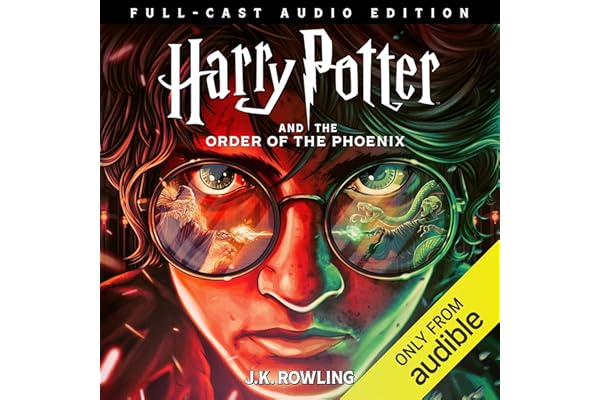
Harry Potter and the Order of the Phoenix (Full-Cast Edition)
Price: $44.99
What Customers Say:
-
CherylLove itGave as a girt
-
Irene AdlerThe wizarding world will never be the same againHarry Potter and The Order of the Phoenix is the fifth book in J.K. Rowling’s Harry Potter series of children’s books.Several weeks ago I eagerly anticipated the arrival of Harry Potter #5 and had preordered it. When I woke up this morning, I found the book right at my doorstep. Elated, I quickly opened the package and started reading.I just finished the book, and I am not one bit disappointed. J.K. Rowling’s writing style is still ever-present in this book, vivid and wondrous as it had been in the previous four books. There are many surprises in the book (like Ron getting to be prefect while Harry doesn’t), but I also think that a lot of the details in the book were extraneous. The book was also a bit on the dark/moody side. When I read it, I was constantly disturbed and worried, and the book no longer had the flippant and jovial tone that the first book had, the original reason why I enjoyed it so much.However, that doesn’t stop this book from being so great. Again, the magic of Hogwarts accompanies Harry, Hermione, and Ron throughout the book, but some developments in the book are disturbing, such as Percy’s separation from the family, Dumbledore’s aloofness in the beginning of the book, and the somber tone on which the book ends. The only characters I felt were unmarred by the morose theme stretched throughout the book were Fred and George Weasley (they operate a joke shop throughout the book).One of my complaints about the book was the length. This installment of the Harry Potter series is the longest at 870 pages. There are only two reasons I can think why J.K. Rowling would do this:1) She gets paid by the word so the more she writes, the more money she makes.2) She is afraid that once she writes all seven books, then she will have nothing more to write about, so therefore, she has to write as much as she can before the momentum of her series is over.Both of those are bad reasons why the book should be long. While the writing isn’t Joyce (concise and perfect in all ways, but slightly unhumanistic), I think that a lot of it is overly verbose. However, I don’t feel that the length of the book is something to complain about. Other people disagree though: in fact, upon hearing that HP5 was 870 pages, he responded, “HOLY….”That doesn’t mean the book is bad though. I would still highly recommend this book and would agree that it is _on par_ with the previous writing of JK Rowling. Even though it is slightly depressing at times, it’s still an excellent read.Now, for a brief summary – don’t read ahead if you don’t want the book spoiled.Harry is first caught fighting two dementors near Privet Drive. As a result of his breaching of the Underage Misuse of Magic, he has to go to a trial, where he defends himself so he won’t get expelled from Hogwarts or get his wand snapped in half. Wizards from the Order of the Phoenix, an underground anti-Voldemort society, come to rescue Harry and take him to a hideout.Once Harry is acquitted of all charges, he finds out that Albus Dumbledore is extremely aloof and that Cornelius Fudge and Percy Weasley do not believe that Voldemort has come back to power. Percy is cold and disattached to the Weasleys because he “betrayed” the family when he went to work for Fudge. Harry also finds out that Ron and Hermione are prefects for Gryffindor, and he is not.Once Harry makes it back to Hogwarts, there are plenty of things to worry about. Aside from the new Defense from the Dark Arts Professor, Umbridge, who is working as a “spy” for the Ministry of Magic, Harry has to contend with O.W.L.’s and people who don’t believe him when he tells them that Voldemort is back.Ron is made Keeper for the Quidditch Team in addition to being a prefect. Fred and George are selling pranks and pills for their joke shop. Tons of homework plague Harry and Ron, causing them many sleepless nights. Also, Umbridge inspects all the teachers as Head Inquisitor and she also disbands all clubs and teams (including the Gryffindor Quidditch Team), so they must reapply for reforming. This happens just as Hermione, Ron, and Harry decide that they are going to create a Defense Against the Dark Arts “study group” themselves. Later on, Harry and the Weasley twins are banned from Quidditch for life by Umbridge.In the middle of the book, Mr. Weasley is attacked. Harry has an out-of-body experience where he is actually a snake and attacks Mr. Weasley. It is even suggested that Harry is being possessed by Lord Voldemort. Harry eventually takes Occlumency (anti-mind reading) lessons from Snape.Right after the first Occlumency lesson with Snape, Harry realizes that the door at the end of the long, dark corridor in his dreams is the entrance to the Department of Mysteries. The next day, Hermione, Ron, and Harry find out from the Daily Prophet that ten Death Eaters escaped from Azkaban. Dumbledore eventually leaves the post as headmaster of Hogwarts and Umbridge takes over. It seems worse and worse everyday and that Voldemort is getting closer and closer to victory.Eventually the book climaxes and as you might suspect, Harry and the rest of the D.A. (Dumbledore’s army) find themselves on a rescue mission to the Department of Mysteries. There is a showoff with Voldemort.There is a main character who dies. I won’t tell you who it is, but it is a main character (not someone minor like Cedric).The book ends on a somewhat sad note, with the Ministry admitting their wrongdoing and that Voldemort is back, aka the start of the “second war.” Let’s hope that Harry can withstand two more years at Hogwarts with Voldemort around…
-
Marty G. PriceNot quite Twain or Dickens, But …J.K. Rowling has produced a great adolescent novel. While coming of age stories are staples of both quality and popular literature, modern “quality” ones tend to be painfully self-indulgent. A century or so ago, Mark Twain’s Huck Finn had the sense to decide that freeing his friend Jim was more important than going to heaven and Dickens’ Pip (_Great Expectations_) learned just how foolish had been his self-indulgent adolescence. The writers understood that purpose resides beyond the self. Then, around fifty years ago, critics became enamored with the likes of Holden Caulfield, and the self-indulgent study of adolescent ennui came into fashion.Granted, the readers receive a far deeper exploration of Holden Caulfield’s psychological makeup than Twain or Dickens ever offered a reader, but we have paid a terrible price for this exploration. Authors and critics stepped forward to claim that solipsistic self-exploration was “what it’s about,” and few seemed ready to say, “Yes, this is what adolescence is like, but you’ve got to step out and take on the world even though the entirety of William James’s ‘blooming buzzing confusion’ seems to be doing its blooming and its buzzing within the confines of your emotions.”Can one experience the confusion of Holden Caulfield and yet set forth boldly as Huck Finn? Harry Potter tries, as the many of us who have not grown up to be self-indulgent agoraphobics have done exactly that. We’ve sorted through the world, discovered the faults and flaws of the outside world, come to terms with our own weaknesses, and occasionally saved the world (or some tiny little piece of it) in the process.Harry Potter is a real adolescent, writ large. He is a wizard; he has a Destiny; he is the hero of childhood fantasy. He is confused, impulsive, traumatized, and full of both anger at the world and self-doubt. In Harry Potter and the Order of the Phoenix, Harry suffers all the deep pangs that are the fodder of modern literature yet manages to stand true to himself at the end. Harry has heart, and, as Dumbledore notes, that is what matters.In the Harry Potter books, Harry tends to create or force the final confrontations. Harry unintentionally cooperates with Voldemort again in this piece, propelled, as always by selflessness rather than malice. Harry may need Voldemort in order to discover what is within himself; Harry also feeds Voldemort as he presses ever greater challenges onto himself, leaving us to ask: is Harry responsible for Voldemort’s increasing power and the consequences of these ever more violent confrontations? It is dangerous to act in a world where we posses only incomplete knowledge, but part of Harry�s appeal is that he does act, rather than retreating Hamlet-like into indecision.Harry also must discover that his finest role models are not perfect; this is another element of the adolescent rite of passage. Harry, always the underdog in the Muggle world and always the defender of the underdog in the world of wizardry, discovers something unsettling in the form of one of Snape’s memories. The revelation explains much of Snape’s animosity toward the Potters and Black, and offers Rowling’s readers an uncomfortable window into the adolescent world. The more rambunctious behavior of Harry and his friends, throughout the books, has consistently appeared as either benign or justified. In our real world, the behavior of “good kids” is all too often neither. Rowling reminds us of the adolescent play that is scarring to all involved: victims, victimizers, and even those who would object but were powerless to do so. And she leaves Harry with the choices of justifying (improperly) his heroes’ actions, rejecting his heroes, or accepting that even the best wizards have flaws.The new Defense Against the Dark Arts teacher epitomizes the Dark Art of the Twentieth Century. Those of us who have lived through 1984 may see her as a figure of ultimate evil, one far more depraved than the merely malicious Voldemort. She is the bureaucrat, the agent of societal convenience and unquestioning obedience to authority. All who would argue with her are not merely wrong, they are misguided or deceitful obstacles to the Truth. Order is all, and Order derives only from unquestioned obedience to the rules as delineated by the State. Her methods of punishment are Kafkaesque; her aims include the destruction of independent thought. Question Nothing! It is basic nature for an adolescent to rebel against such a figure; what is difficult is efficacious rebellion, rather than pointless or self-destructive opposition. Can an adolescent learn when to fight and when to pretend acquiescence?Yes, this book is dark in tone, raw with the emotions of adolescence and with its external actions a perfect mirror to Harry’s confused, angry young mind. In the world of childhood, tomorrow always dawns fresh and new; for an adult, tomorrow’s dawn carries the consequences, for good or bad, of the night before. For an adolescent, the dawn is always painful as consequences are a fresh addition to the world, and last night’s experiments in living were sure to have produced at least some undesired results. The lessons are intense, the learning rapid, but understanding may be long years away. The brightest thought, and Rowling lets us end with this thought, is that there are others who have felt the pain of adolescence, who have confronted the great human questions, and who have not only survived but have grown into strong, effective adults.Harry Potter may be letting a generation of kids know that one’s life matters, even in its harshest, most confused periods. It should be letting a generation of critics know that there is more to adolescent self-discovery than simpering self-indulgence. This book suggests that Huck Finn can feel like Holden Caulfield on the inside, yet still behave as Huck Finn. It also suggests that there is no excuse for behaving like Holden Caulfield — and I like that suggestion.
Harry Potter and the Order of the Phoenix (Full-Cast Edition) is one of the best-selling products with 97099 reviews and a 4.8/5 star rating on Amazon.
Current Price: $44.99